
Eating Together: Why Shared Meals Boost Digestion
Eating Together: Why Shared Meals Are Good for Your Gut and Your Mind
I noticed it first at my own dining table.
I grew up sitting at that table with my family, every meal and I've carried that straight into my own family now. It's the banter. The laughs. Watching someone's face when they try something they're not so sure about — and then watching that same face when they absolutely devour it anyway.
I know that's not everyone's experience anymore. For a lot of families, food has become a necessity rather than a moment — eaten on the go, separately, in bedrooms, in between work. Grabbed rather than shared.
Food with family doesn't feel like a chore. It feels like joy. Passing bowls. Someone reaching over to fill your plate before you even ask. Telling each other about your day between mouthfuls. There's something about that whole exchange — the sharing, the serving, the nourishing someone else — that changes the food itself. It stops being fuel and starts being connection.
And that's exactly what I love about running the supper clubs. Watching someone take a bite and go "ahhh." Hearing "I need this recipe" or "have you tried adding X to yours?" across the table. Being of service — cooking for people, feeding people — does something to me too. It's not just about the meal going out. It's about what comes back.
As a gut health coach, I've started to wonder how much of that feeling is actually digestion. And it turns out, there's real research behind it.
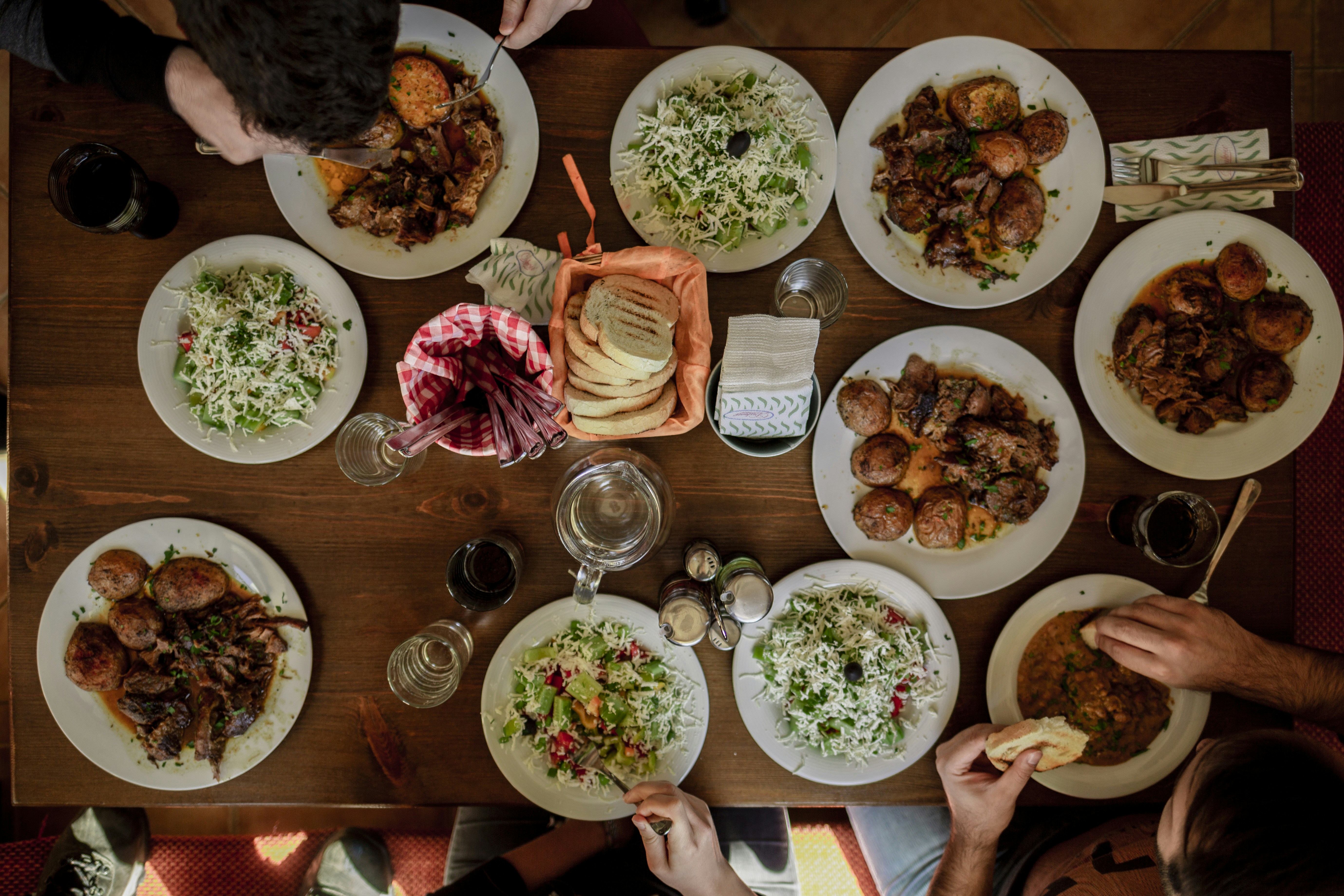
How Eating With Others Helps Your Body Relax and Digest
When you eat surrounded by people you trust, your nervous system shifts. The worries quiet down. You're not rushing, not eating standing at the counter, not scrolling while you chew. You're present — because the company is holding your attention instead.
That matters more than you'd think. Digestion runs best when your body is in a calm, "rest and digest" state, not a stressed one. A relaxed brain means a relaxed gut. So the feeling I get at a full table — that easing, that letting go — isn't just emotional. It's physiological too.
Why We Eat Slower (and Digest Better) in Company
One of the clearest findings in the research on shared meals is about pace. When people eat in company, they naturally slow down — there's conversation, there's passing things around, there's a rhythm to it that's just not there when you're eating alone. And eating more slowly gives your body time to actually register that it's full, which means less overeating and easier digestion overall.
That's the passing-the-bowl effect, in a nutshell. It's not just generous. It's genuinely better for you.

The Research: What Studies Say About Shared Meals and Health
Beyond digestion, there's a growing body of research on what regular shared meals do for us more broadly. Here's what the studies actually show:
Taiwan, ~2,000 older adults, 10-year follow-up (BMJ Open): men who shared meals with others two or three times a day were significantly less likely to die during the follow-up period than those who mostly ate alone — largely because shared meals tended to come with healthier eating habits overall.
South Korea, 8,500+ adults (Nutrition Journal): eating with others was linked to noticeably better overall diet quality.
United States, ~900 parents (EuropePMC): more frequent family meals were associated with higher self-esteem, fewer depressive symptoms, and lower stress — and also with eating more fruit and vegetables.
China, 370,000+ schoolchildren (Child Indicators Research): regular family meals correlated with fewer depressive symptoms, greater life satisfaction, and better mental health overall.
A review of 65 studies on young people (PubMed): found that sharing meals regularly was linked to less obesity, a lower risk of developing an eating disorder, and better academic achievement.
A review of 29 studies on loneliness and diet (Appetite/ScienceDirect): found that loneliness and social isolation are associated with lower overall diet quality — the flip side of the same coin.
Researchers are honest that it's hard to fully untangle cause and effect here — people who already have more time, less stress, or stronger relationships may simply find it easier to eat together in the first place. But taken as a whole, the evidence keeps pointing the same way: sharing food with people you care about supports both your body and your mind.
(Research summarised from studies covered by ZOE — click through on any study above to read the original source for yourself.)

Why We Bring People to the Table at Warmth & Wellness
This is the part that gets me. It's not just about serving good food. It's about giving people a table where their nervous system can finally exhale. Where the gut, and the heart, both get to unclench for an hour.
When we put a plate of something nourishing in front of someone at Warmth & Wellness, we're not just feeding them. We're giving their body permission to slow down, digest properly and actually enjoy what's on the plate — while their mind gets fed by the people around them.
We get to see it every time. The "ahh" when someone takes that first bite. The "I need this recipe." The face someone pulls when they try something unfamiliar, followed by the one they pull two minutes later when the plate's empty and they're asking for seconds. It's the exact same thing I grew up with at my own family table — just with a few more women around it now.
That's the whole point of the supper club, really. Good food is only half of it. The table is the other half.
If your own meals have become something grabbed on the go, eaten alone, eaten fast — I'd gently say this: you don't have to overhaul everything. Start with one meal a week, shared, no phones, plates passed hand to hand. Your gut, and everyone else's, will thank you for it.